When the Paper Arrived by Train
Railway newspaper distribution depended on more than the track: learn how timetables, station transfers and local sellers shaped access to each edition.
The usual mistake is to assume that a newspaper reached every town on a railway line. In railway newspaper distribution, a missed departure or an absent local seller could leave readers waiting, even when the press and destination were connected by track.
Printing deadlines
A newspaper’s journey began at its printing works. Once copies were ready, staff had to sort them for different destinations and get each bundle to a station before the useful service left.
That timetable could shape the edition itself. If a story became ready after dispatch, the publisher might hold the bundle for a later train, send it by another route or leave the news for a later edition. A railway offered speed within its schedule, not instant delivery.
Think of a timetable as a row of doors: the bundle has to reach the right one before it closes. Miss it, and the next opening may come too late for that day’s readers.
Last-mile arrangements
Rail travel was only part of the journey. Someone still had to collect bundles at the receiving station and take them to a shop, subscriber or local carrier. The arrangement varied by place, so a railway connection alone cannot tell us whether copies were actually available to readers.
For a specific historical claim, look for evidence tied to a particular place and period: newspaper notices about distribution, railway timetables, publishers’ records, station or shop accounts, and local directories. These sources can help establish which services operated and who handled the final delivery. Without such evidence, describe a possible arrangement as a possibility, not as a documented fact.
Where delays begin
The edition arrives stale. The press may have missed a suitable departure, or a connection may have involved a long wait. A publisher could compare closing times with the available services and decide whether a later edition or another route made sense.
One town gets copies while a nearby town does not. A direct service may serve the farther place more conveniently than an indirect route to the nearer one. The relevant comparison is the complete journey and local collection arrangements, not distance alone.
Bundles reach a station but not readers. There may be no agreed shop, carrier or subscriber collection. Before adding a destination, a distributor would need to identify who could take the bundles onward.
Some places have leftovers while others run short. Local sales reports could help a distributor decide whether to change the quantities sent to each outlet. If reliable reports were unavailable, the publisher would have less basis for adjusting bundles confidently.
Railway newspaper distribution?
Why did railways help newspapers travel?
Rail services linked printing centres with towns that could be slow to reach by road. Known departures also gave publishers a timetable around which to organise dispatch, subject to onward connections and local collection.
Did every station receive newspapers?
No. A station on a route did not by itself mean a publisher had arranged for bundles to stop there or continue to readers. Local demand and the availability of a seller or carrier mattered too.
How did train times affect the news?
Reports ready before dispatch could be included in an edition sent on that service. Material ready later might wait for another departure or be held for a subsequent edition.
What could happen after a missed connection?
A bundle might wait, take another route or arrive too late to be useful. The actual outcome depended on the services and local arrangements available at that place and time.
A route comparison
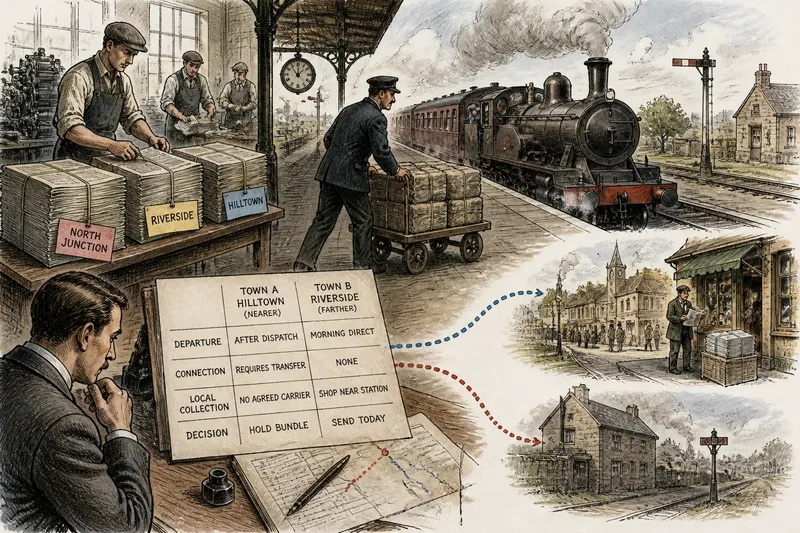
Imagine a publisher in a port city sending invented test bundles to two inland towns. In this hypothetical case, the farther town has a direct morning train and a shop near its station; the nearer one needs a transfer and has no regular carrier.
The publisher first checks the departure times and sees that the nearer town’s connection follows the planned dispatch. Next, the publisher asks whether a local shop or carrier can collect its bundle and learns that neither has agreed to do so. The decision is to send the farther town’s bundle on the direct service, while holding the nearer town’s bundle until a collection arrangement is made. The expected observable result is that the farther town’s shop can offer copies after the train arrives; the nearer town receives no promised delivery until someone is available to take the bundle onward.
For railway newspaper distribution, the useful question is not merely how far a paper travelled, but where its journey depended on a person or service beyond the track. A timetable can explain an opportunity to send copies; local records and distribution arrangements are needed to establish whether readers could actually obtain them.