How Broadcast News Changed the Reach of Public Events
Broadcast news brought distant events into homes through voice and images. See how radio and television changed news circulation without replacing print.
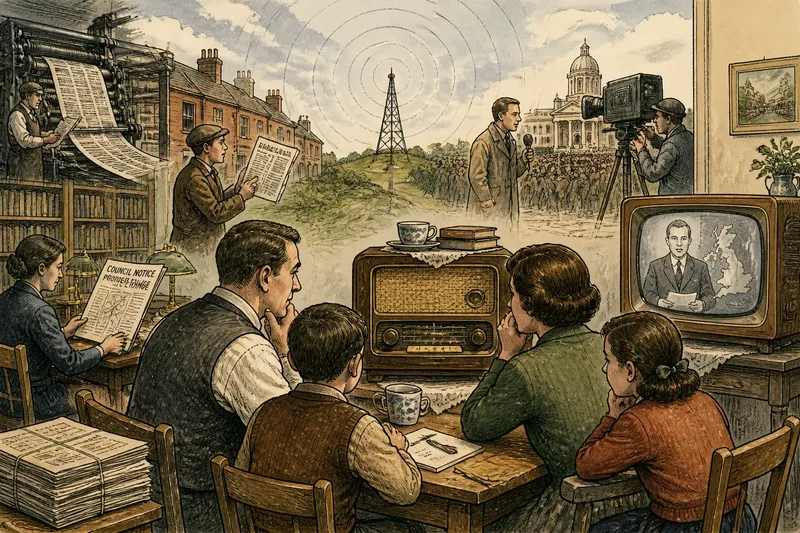
The common mistake in describing broadcast news is to call it print delivered faster. Radio and television changed the route news took: from a page encountered in a reader’s own time to a voice or image transmitted on a programme’s schedule. In Britain, the BBC began regular radio broadcasting in 1922, and its television service followed in 1936, giving this shift a clear historical setting.
Print before broadcasting
Newspapers, handbills and posted notices travelled as physical objects. A reader could stop at a page, return to a paragraph or pass a copy to someone else. The news might concern the same event for many people, but they did not necessarily encounter it together.
That flexibility was one of print’s strengths. Readers set their own pace and order: a headline could be skimmed, a report reread, or the paper put aside. Circulation depended on the movement of copies and on the time people had to read them.
Radio’s spoken sequence
Radio placed a presenter’s voice in homes and shared public spaces at a stated time. A bulletin moved from one report to the next, with editors deciding the order and speakers fitting information into a limited programme. Unlike a newspaper, it could not be skimmed or reread as it went along.
Sound became part of the report. A correspondent’s voice, a pause or a field recording could convey something beyond the written words. But listeners who missed a sentence had to wait for a repeat or seek another account; the transmission continued whether or not everyone was ready.
A receiver did not need to be held by every listener. People gathered near a set in a home, workplace or public venue, though access depended on the receiver, reception and the programme available. The voice could make a faraway event seem close without putting the listener at the scene.
Television’s chosen frame
Television added pictures to the scheduled bulletin: a presenter, a map, film footage or a correspondent speaking from a location. The images could help viewers place a report, but the camera showed only what its crew and editors selected. A crowd in frame was not every person involved; a map could show a route while omitting what life along it was like.
The difference from print is like the difference between reading a letter and hearing someone read it aloud: the words may overlap, but voice, pace and the setting alter the encounter. Television made a presenter and selected scenes visible, while print remained easier to handle as a record that readers could revisit.
How did broadcasts travel?
Did every listener hear the same bulletin?
People tuned to the same programme could hear the same sequence of reports. Reception, access to a set and local programming affected who could listen, so a shared transmission did not mean a universal audience.
Could audiences choose the order?
Not as they could with a newspaper. Editors set the sequence and the bulletin moved on, although listeners could tune away, arrive late or seek another programme.
What did live reporting add?
A live link could bring a correspondent’s voice from a distant place into a broadcast while events were unfolding. It also carried the limits of the connection: a report might be partial, unclear or revised as more information arrived.
Did broadcast replace newspapers?
No. A broadcast offered a timed account in sound or pictures, while print allowed slower reading and easier reference. The forms served different purposes and could be used together.
Broadcast news in Britain
Early BBC radio broadcasting established a regular programme service in Britain in 1922; BBC television began regular service in 1936. These dates mark the start of services, not the instant when every household gained access. The distinction matters: transmission could extend beyond a newsroom, but reception depended on equipment, signal and the broadcaster’s coverage.
As broadcasting developed, a bulletin could make a distant public event part of an ordinary day. A listener did not need to travel to the event or obtain a newspaper carrying its account. Yet the broadcast still had a particular point of view: editors chose which events to cover, whose voices to include and how much time each report received.
What changed for audiences?
Broadcast news shifted some control away from the individual reader and towards the programme schedule. Print let people pause and choose what to read first; radio and television organised reports in sequence. Their audiences could respond to the same account, but they could not interrupt the transmission to add a local perspective.
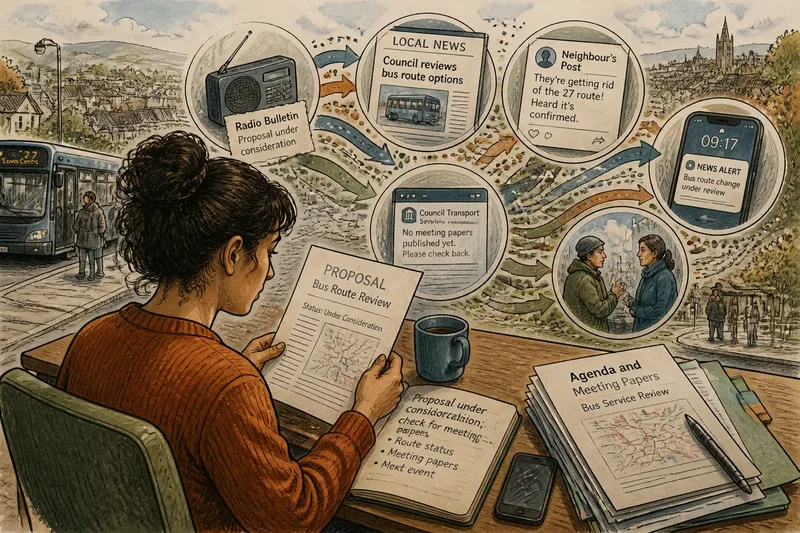
Say a family in an invented town hears a radio bulletin about a proposed change to its bus route. They listen to the whole report, note that it mentions a council decision but not the affected stops, then check the council notice at the library. The result is a shared account to discuss alongside a more local source; the trade-off is that the broadcast gives a brief overview, not every detail riders need.
Broadcast news changed how public events travelled: a voice or selected image could reach people who were far from the scene, while print retained its value as a record to revisit. To understand broadcast news, follow both the signal and the editorial choices behind it—who could receive it, which reports made the programme and what the format left unsaid.