The Always-On Myth: Why More News Can Mean Less Attention
Follow a developing news story without losing its thread: distinguish confirmed changes from repeated reactions, and keep the context that makes updates clear.
The common mistake with a developing news story is treating every new appearance as a new development; the cost is losing track of what has actually changed. A council notice, a reporter’s update and a neighbour’s post may all refer to the same decision, but arrive stripped of their relationship to one another. The problem is not simply too much news. It is a circulation system that can detach an item from the context that made it intelligible.
News in transit
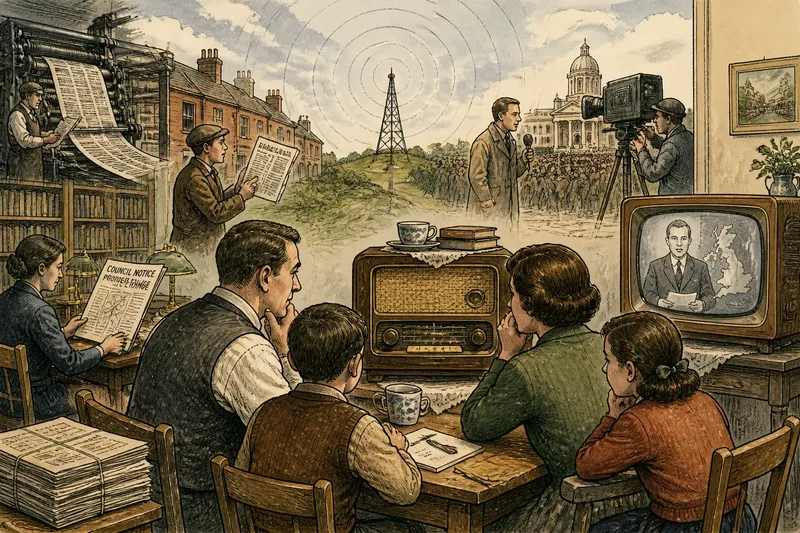
A story travels through a chain: an institution publishes a document, a newsroom reports on it, a radio bulletin condenses it, and people pass on the parts they find striking. Each hand-off makes the news easier to encounter somewhere else. It can also change what is prominent. A procedural detail may disappear, while a vivid phrase survives every retelling.
That movement is part of news circulation, not an accidental distraction from it. The same report can reach people through a local paper, a WhatsApp group, a push alert or a conversation at the bus stop. Each route supplies a different frame: the alert offers immediacy, the document supplies the formal wording, and a neighbour may know which streets or services are affected.
But a route is not a source of equal authority for every question. A forwarded post can point towards a useful lead without establishing that a claim is true. An official notice can confirm what an organisation has decided, but may not explain how residents experience the change. Understanding where an item came from is part of understanding the item.
Repetition and change
A story often returns because it has acquired a new event: a decision, a meeting, a document or a response from someone affected. It may also return because another outlet has recast an existing report or a platform has surfaced an older post. Repetition can broaden reach, but it can give an unchanged situation the feel of constant movement.
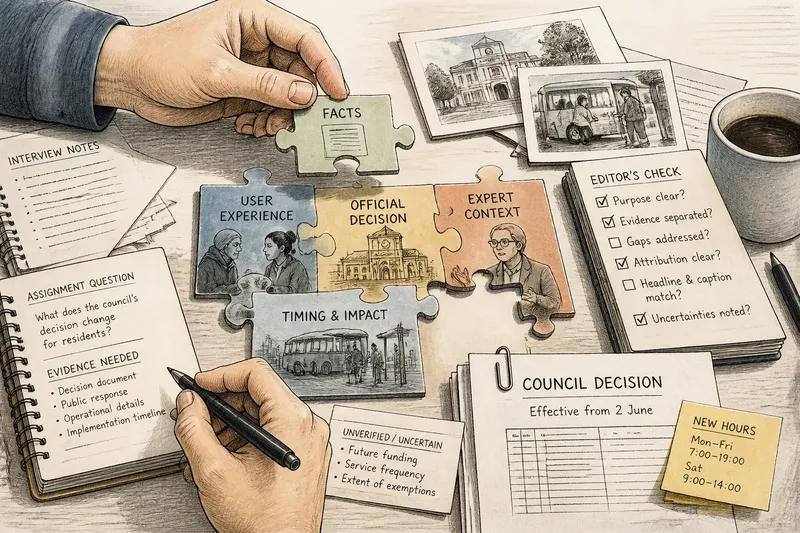
One useful distinction is between a new voice and a new status. A fresh reaction may add perspective, while leaving the underlying decision untouched. A newly published agenda, by contrast, can tell readers what will be discussed and when. Both may be worth attention; they answer different questions.
Think of a news story as a paper map passed between travellers. Each person may circle a different landmark, but the marks only help if the route and starting point remain visible. Without that shared reference, a dramatic circle can look like a destination.
Following a local proposal
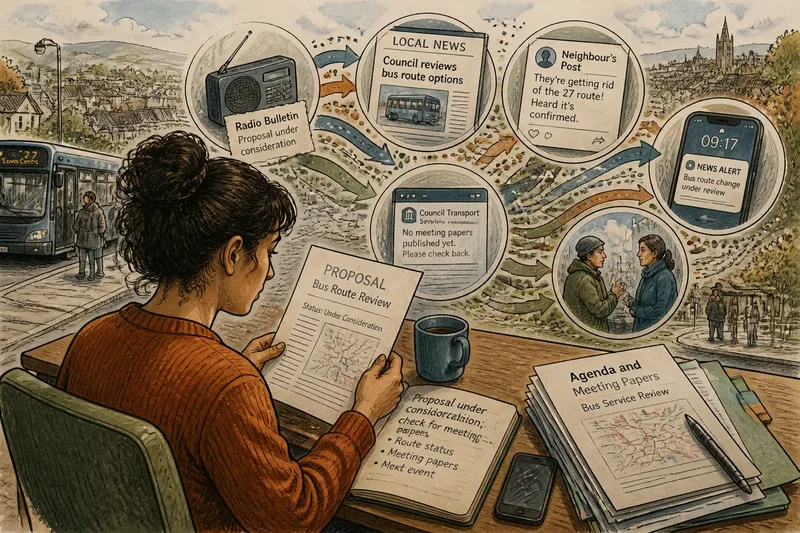
Say Mara, an invented reader, hears that her council may change a local bus route. Her starting inputs are a radio bulletin saying the proposal is under consideration, a neighbour’s post claiming the route will disappear, and a council transport page that has not yet published meeting papers. She needs the bus for occasional trips, but has no journey to make immediately.
Mara first opens the council page and confirms that the route change is a proposal, not an agreed closure. She then reads a local news report to understand the stated reason for considering it, and treats the neighbour’s post as a lead rather than confirmation. Finally, she writes in her phone: “Proposal under consideration; check for meeting papers.”
At her next look, meeting papers have appeared. Mara reads the relevant section and learns that councillors are due to discuss the proposal; no final decision is recorded. The resulting answer is limited but useful: the route is still under consideration, the rumour of an agreed closure is not supported by the documents she has seen, and the discussion is the next event that could alter the story’s status. Her trade-off is clear: she has not collected every reaction, but she can distinguish the formal process from the circulating claim.
What deserves attention?
- Source of a claim: Check who first published it; if a named organisation or reporter is identifiable, follow that source, but if it is an unattributed repost, treat it as unconfirmed and seek an original source.
- Document behind the report: Check whether the story links to a notice, agenda or decision; if the document is available, use it to verify the formal status, but if it is missing, keep the status provisional.
- Date of the item: Check when the report or post was published; if it predates a later decision, find a current account, but if it is still current, use it as context rather than assuming it is outdated.
- Kind of update: Check whether the item records a decision, a new document or only a reaction; if it changes the story’s status, follow the new development, but if it adds commentary alone, read it for perspective rather than treating it as a changed outcome.
- People affected: Check whose experience the report includes; if affected residents or service users are heard, use that account to understand consequences, but if they are absent, look for another source that supplies that perspective.
- Next formal event: Check for a meeting, response deadline or published timetable; if one is listed, note it as the next point to check, but if none is stated, avoid inventing a timetable and wait for an announced development.
Which source answers what?
Is an official notice enough?
An official notice is useful for the wording of a proposal, decision or process. It may not explain the full local impact, so pair it with reporting or first-hand accounts when those questions matter.
Can a social post be useful?
Yes: it can point to a document, an event or an affected person’s account. Check the origin and supporting evidence before repeating its factual claims.
What counts as a real update?
A new decision, published document or confirmed event can change a story’s status. Another comment on the same facts may add a viewpoint without changing what has happened.
How should I handle conflicting accounts?
Keep the disagreement visible instead of choosing the most confident-sounding version. Compare the original documents and named sources, and wait for clarification if the central claim remains unresolved.
Keep the thread intact
For Mara, the useful record is not a list of every headline. It is a short account of what is confirmed, what remains unsettled and what could change the status. That gives her a way to re-enter the story without starting again at the loudest post.
News circulation will keep carrying fragments across platforms and conversations; readers can restore context by tracing an item back to its source and asking what changed in transit. For an ordinary story, the most useful question is often not “What else has appeared?” but “What new evidence or event would change my understanding?” If the bus proposal affects an actual journey, Mara should check the council or operator’s current notice before making plans.