The Newsroom Editor Who Connects a Story’s Parts
A newsroom editor helps turn reporting into a clear, accountable story, from setting its purpose to checking headlines, captions and unresolved questions.
The most common mistake is treating a newsroom editor as a copy polisher who arrives at the end. That can leave reporting, verification and presentation at odds, costing readers a clear account of what happened and how the newsroom knows. A newsroom editor makes decisions about a story while it is still taking shape.
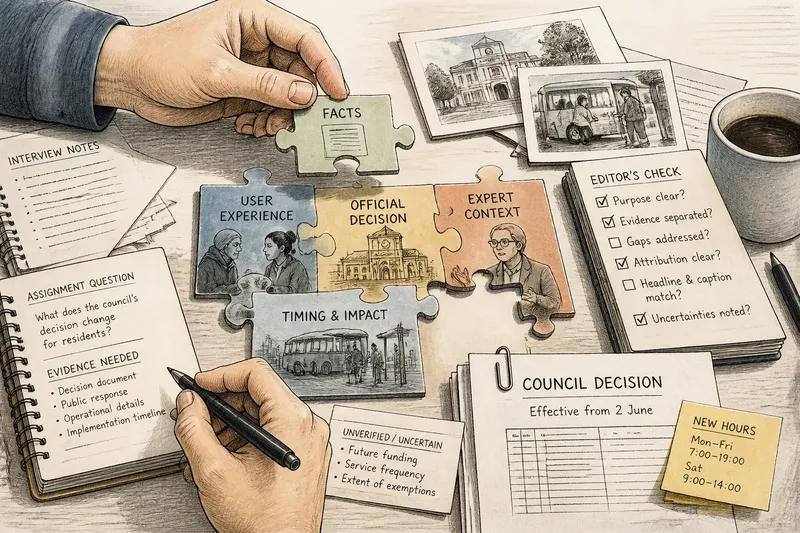
The work is less like varnishing a finished table than sorting the pieces of a jigsaw as they arrive. A reporter gathers interviews and documents; a fact-checker scrutinises claims; a picture editor considers images. The editor decides what the story needs next, what belongs in it and what the evidence can support.
Different editorial roles
“Editor” describes several newsroom jobs. A commissioning editor chooses what to pursue and sets the assignment. A line editor works on wording and structure. A section editor oversees a subject area. In a small newsroom, one person may handle several of these tasks; in a larger one, they may be divided among colleagues.
Whatever the job title, editorial decisions do not replace reporting. The reporter gathers and describes the evidence. Editors can question whether the draft answers its stated purpose, while a fact-checker or specialist editor may examine particular claims. Each has a distinct contribution; the published account should make clear what is established, attributed or still uncertain.
Say a reporter is writing an invented story about a local authority changing the hours of a public service. Interviews with users describe the effect, while an official decision states when the change is due to begin. The editor notices the draft gives the announcement but not the new hours. The reporter checks the decision, then revises the opening to state the change and its timing, with users’ accounts presented as experience rather than proof of the official details. The resulting draft gives readers the essential information and keeps the two kinds of evidence distinct.
Match support to need
The useful editorial approach depends on what is holding a story back. Several kinds of support can be needed at once; the important thing is to know which task needs attention now.
- If the story is still an idea: Check whether the reader’s question and the evidence needed to answer it are clear. If both are clear, agree the assignment and proceed; if not, refine the question before reporting begins.
- If reporting is active and the facts are changing: Check which claims are confirmed and which remain disputed. If the distinction is clear, continue reporting on that basis; if it is not, ask the reporter to verify the conflict or show the uncertainty in the draft.
- If the draft feels scattered: Check whether each section helps answer the story’s central question. If the sequence is hard to follow, reorder or remove material; if the structure works, move on to sentence-level editing.
- If the copy is readable but claims are complex: Check whether records, technical terms and attributed statements have been examined. If support is adequate, retain the claims with precise wording; if not, seek specialist review or qualify or omit the unsupported material.
- If the story is ready for publication: Check that the headline, standfirst, links and captions match the text. If they do, prepare the story for publication; if they overstate or confuse the account, revise them before release.
- If a new contribution arrives late: Check whether it changes a central fact or adds secondary context. If it changes a central fact, update the affected sections and display; if it is useful but not essential, consider holding it for a later story.
Keep the question useful
“Report on the council meeting” names an event but leaves the purpose vague. “Explain what the council’s decision changes for residents” gives the newsroom a more useful question. The reporter can seek evidence about the decision; the editor can check whether the draft explains its practical meaning without implying more than the material supports.
That question may need to change as the reporting develops. A document might fail to support the initial account, or an interview might reveal that the dispute concerns how a decision will be applied. The editor should help reset the focus, then identify which parts of the assignment need new reporting. Fresh evidence should not be forced into an old framing just because the draft has already been written.
Publication details matter
A headline, image caption and link all shape what readers understand. A headline can overstate a finding; a caption can imply a chronology that the image cannot establish; a link can point to a document described inaccurately in the text. Editors check these items against the reporting, and arrange changes when the underlying account changes.
Careful wording also distinguishes evidence from claims. “The report says” identifies a source; “the records establish” makes a stronger assertion. “Officials expect” describes a forecast, not an observed outcome. The right phrasing depends on what the newsroom has actually confirmed.
Questions about newsroom editors?
What does a newsroom editor do?
A newsroom editor may shape an assignment, edit a draft, oversee checking or prepare presentation. The exact responsibilities depend on the newsroom, but they centre on making editorial decisions that help the published story serve its purpose.
How is an editor different from a proofreader?
A proofreader focuses mainly on spelling, punctuation and consistency. An editor may also question the story’s focus, evidence, order, omissions and display, and ask for factual or contextual gaps to be addressed.
When should a reporter involve an editor?
Involve an editor when the assignment is unclear, evidence conflicts, the story’s focus shifts or a key response is missing. Raising the issue early can help redirect reporting before the draft rests on an unsupported assumption.
Who makes the final editorial decision?
That depends on the newsroom’s delegated roles and publication process. Editors make decisions within their remit, while serious disputes may need to be raised through the newsroom’s own procedures.
Where the work shows
The contribution of a newsroom editor is easiest to see in the decisions a reader no longer has to puzzle over: what changed, which claims come from which sources, and what remains unresolved. The editor’s work may involve assignment, structure, checking or presentation, depending on what the story needs.
When considering what a newsroom editor does, look at the reader’s path through the published account. A clear opening, carefully attributed evidence and accurate display make it easier to distinguish confirmed details from claims and questions still open. That distinction is useful well beyond the page: it gives readers a sound basis for discussing and sharing the news.